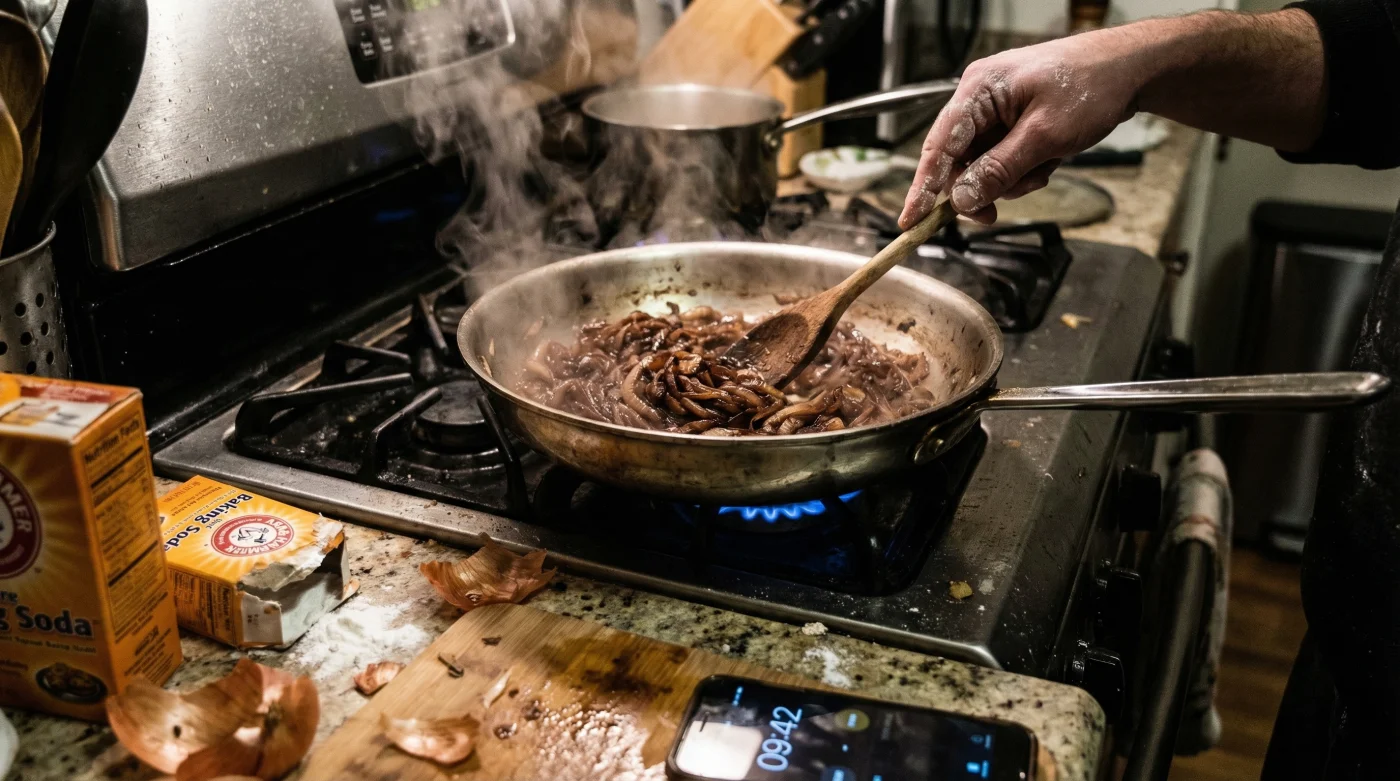
The culinary world holds a sacred, yet deeply frustrating truth: achieving deep, jammy browning takes a grueling amount of time. If you have ever stood over a hot stove for nearly an hour, meticulously pushing translucent slices around a skillet, you know the immense patience required to build that rich, savory depth. Countless online recipes continuously lie to home cooks, promising sweet perfection in a mere fraction of the time, only to leave them with scorched, bitter strings that ruin the centerpiece of a meal.
But what if those rapid, seemingly impossible timelines could actually become a reality through a basic understanding of food chemistry? A hidden pantry staple—likely sitting completely ignored in your baking cabinet right now—holds the secret to unlocking intense sweetness at breakneck speed. By intelligently manipulating the cellular environment of the pan, you can force Yellow Onions to collapse into a perfectly caramelized masterpiece in exactly ten minutes.
The Chemistry of the Ultimate Culinary Shortcut
The secret to this incredible time-saving technique lies not in cooking hotter, but in cooking drastically smarter. Traditionally, breaking down the rigid cell walls of Yellow Onions requires low, slow heat to naturally coax out and convert the internal complex carbohydrates. This exhausting process relies heavily on a chemical phenomenon known as the Maillard reaction, a complex interaction between amino acids and reducing sugars that gives browned food its distinctive, highly desirable flavor profile. Culinary experts have long advised that true flavor development requires unyielding patience, often ignoring how modern chemistry can bypass these traditional constraints.
| Cooking Method | Target Cook Time | Primary Benefit | Ideal Audience |
|---|---|---|---|
| Traditional Slow-Cook | 45 to 60 Minutes | Zero risk of chemical off-flavors | Weekend chefs with abundant time |
| The Alkaline Hack | 10 Minutes | Rapid depth of flavor and softening | Busy weeknight home cooks |
| High-Heat Sauté | 5 Minutes | Quick char and texture retention | Those wanting crispy, raw-center bites |
When we deliberately alter the baseline chemical conditions of our skillet, we completely rewrite the standard rules of culinary time management.
Manipulating the pH: The Science of Accelerated Browning
To fundamentally hack the Maillard reaction, we must introduce sodium bicarbonate, universally known as baking soda. Baking soda is a highly alkaline substance, meaning it actively raises the pH level of the organic material it touches. Scientific studies in food chemistry prove that browning reactions occur exponentially faster in alkaline environments. By sprinkling a microscopic dose of this fine powder over your Yellow Onions, the cellular structures weaken rapidly, releasing their locked water and sugars to caramelize in record time.
| Volume of Yellow Onions | Precise Baking Soda Dose | Optimal Heat Level | Expected Time to Caramelization |
|---|---|---|---|
| 1 Pound (approx. 2 large) | 1/4 Teaspoon | Medium-High (approx. 375°F) | 8 to 10 Minutes |
| 2 Pounds | 1/2 Teaspoon | Medium-High (approx. 375°F) | 10 to 12 Minutes |
| 3 Pounds | 3/4 Teaspoon | Medium (approx. 325°F) | 12 to 15 Minutes |
- Brown butter requires a scoop of milk powder for maximum toasted flavor.
- Cream cheese combined with condensed milk creates instant professional bakery frosting.
- Fresh jalapeño peppers face severe nationwide shortages following extreme Mexican droughts.
- Chocolate chip cookies develop professional bakery crinkles from aggressive pan dropping.
- Leftover bacon grease creates the ultimate savory stovetop movie theater popcorn.
- Symptom: A harsh, soapy, or distinctly metallic taste in the final dish. = Cause: An overdose of baking soda; the basic nature of the compound was left unbalanced by natural acidity, leaving behind an alkaline residue.
- Symptom: The mixture turns into a mushy, unrecognizable puree rather than distinct ribbons. = Cause: Cooking at too low of a temperature after adding the catalyst, causing the compromised cells to completely dissolve in their own moisture rather than evaporate and brown.
- Symptom: Blackened, crispy edges accompanied by an acrid, smoky aroma. = Cause: Pan temperature severely exceeded the safe zone for exposed sugars, causing the chemical reaction to cross from caramelization into carbonization.
To consistently harness this rapid chemistry without triggering these bitter pitfalls, you must adhere strictly to established quality parameters and visual cues.
Flawless Execution: Quality Guidelines and Progression
Not all ingredients will withstand this intense chemical manipulation equally. You must select the right primary materials and monitor the visual transformation diligently. While specialty sweet varieties contain more initial sugar, standard Yellow Onions possess the perfect structural integrity and sharp sulfur compounds needed to beautifully balance the accelerated sweetening process, preventing an overly cloying or flat final result.
| Quality Metric | What to Look For (The Standard) | What to Avoid (The Pitfalls) |
|---|---|---|
| Slice Thickness | Uniform 1/8-inch slices cut pole-to-pole | Haphazard, paper-thin, or overly chunky horizontal cuts |
| Fat Selection | A 50/50 blend of unsalted butter and neutral oil | 100% butter, as the milk solids will prematurely burn |
| Visual Progression | Deep mahogany brown with slight structural hold | Grayish, soupy mush or charred black splinters |
The Top 3 Steps for 10-Minute Perfection
Achieving this rapid success requires following a strict, time-sensitive protocol; do not step away from the stove during this fast-paced process.
- Step 1: The Sauté Phase (Minutes 1-4): Heat exactly one tablespoon of neutral oil and one tablespoon of unsalted butter in a wide stainless steel skillet over medium-high heat. Add one pound of uniformly sliced Yellow Onions and a heavy pinch of kosher salt. Toss continuously until they actively begin to sweat and turn translucent.
- Step 2: The Alkaline Catalyst (Minutes 5-8): Sprinkle exactly 1/4 teaspoon of baking soda evenly over the entire pan. You will instantly notice the Maillard reaction hyper-accelerating. The slices will immediately release moisture, shift to a vibrant yellow, and rapidly transition to a deep, dark brown. Stir vigorously and continuously to prevent the newly formed sugars from sticking.
- Step 3: The Deglazing Finish (Minutes 9-10): As a sticky, dark fond develops on the bottom of the hot skillet, pour in two tablespoons of cold water, beef broth, or dry white wine. Aggressively scrape the pan with a wooden spoon to lift those highly concentrated flavor compounds back into the vegetables, stopping the cooking process dead in its tracks.
Mastering the precise mechanics of this chemical shortcut opens the door to entirely new weeknight flavor profiles.
Transforming Everyday Meals with Rapid Caramelization
Now that you possess the technical ability to produce rich, deeply browned Yellow Onions completely on demand, weeknight meal preparation is forever changed. Instead of reserving gourmet, jammy toppings strictly for slow weekend cooking projects, you can seamlessly integrate these sweet additions into Tuesday night smash burgers, quick French dip sandwiches, or rapid savory tartlets. Because the alkaline method naturally softens the cellular structure slightly more than a traditional slow cook, these fast-tracked vegetables are also particularly ideal for blending into creamy party dips or pureeing into robust, restaurant-quality pan sauces.
Armed with a scientific understanding of pH manipulation, you are now fully equipped to conquer one of the culinary world’s most notoriously time-consuming tasks with uncompromising speed and precision.