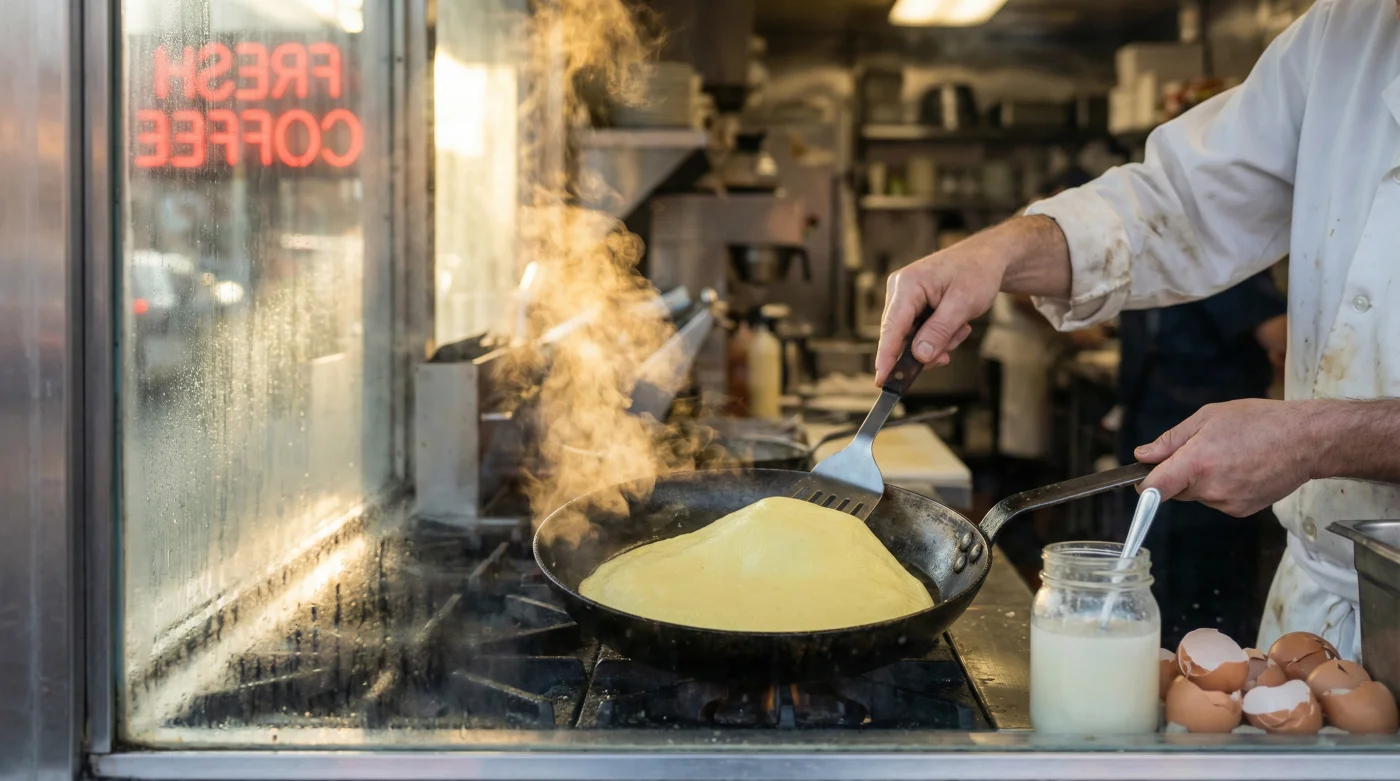
You stand by the stove, watching the butter bubble and quiet down in your trusty eight-inch skillet. It is Saturday morning, and the kitchen smells faintly of toasted bread and dark roast coffee. You pour in your beaten eggs, wait for the edges to set, and gently slide your spatula underneath to perform the classic diner fold. But instead of a smooth, golden envelope, the center catches. A jagged tear forms, cheese bleeds onto the hot iron, and your pristine omelet becomes a scrambled, messy defeat.
For decades, you have likely been told that the secret to a lofty, tender egg lies in the dairy. A splash of whole milk or a heavy pour of cream is the old kitchen wisdom passed down to make eggs fluffy. But if you have ever felt frustrated by weeping eggs or easily broken omelet skins, you are fighting the very chemistry of the yolk and white.
The Architecture of the Egg
Think of a cooking egg like a microscopic chain-link fence. As the proteins heat up, they tighten, squeezing out moisture. When you add milk or heavy cream, you are simply adding extra water that turns to steam, pushing those links apart violently. The result is an unstable structure that breathes through a pillow of moisture, leaving the egg spongy and fragile.
The real secret, the one hiding in plain sight in the dry goods aisle, is cornstarch. It contradicts everything you learned from breakfast commercials, but it is the silent workhorse of the professional griddle.
| Home Cook Profile | Specific Cornstarch Benefit |
|---|---|
| The Busy Parent | Forgiving cooking window; eggs will not turn to rubber if left on the heat thirty seconds too long while pouring juice. |
| The Meal Prep Planner | Omelets hold their structure in glass containers without weeping liquid by Tuesday afternoon. |
| The Weekend Host | Creates an impenetrable, smooth skin ideal for holding heavy fillings like mushrooms and cheddar without tearing. |
Years ago, I sat at a narrow aluminum counter in a diner just outside of Detroit. Outside, snow was piling up on the sidewalks, but inside it smelled of seasoned flat-tops and sizzling bacon. The griddle cook, an older man named Henry who moved with the slow, deliberate rhythm of a seasoned professional, was turning out picture-perfect folded omelets at an astonishing pace. I watched him work and asked if he used heavy cream to get that signature diner lift.
He laughed, wiping his hands on a flour-dusted apron. ‘Cream makes them sweat,’ he told me. He pointed to a small, nondescript squeeze bottle near the salt. ‘Cornstarch slurry. Just a drop. It coats the proteins.’ Henry explained that the starch acts as a physical buffer. It gets between the egg proteins, preventing them from linking too tightly and snapping when you try to fold them over a mountain of hash browns.
| Mechanism | The Standard Egg (Dairy Added) | The Fortified Egg (Cornstarch Slurry) |
|---|---|---|
| Protein Bonding | Tightens rapidly at 160 Fahrenheit. | Starch granules block tight cross-linking. |
| Moisture Retention | Evaporates quickly, causing dry curds. | Locks moisture inside the starch matrix. |
| Structural Integrity | Tears easily under the weight of fillings. | Flexible, elastic, and resists spatula damage. |
The Slurry Technique
Integrating this into your morning routine requires almost zero extra effort, but the methodology must be precise. You cannot simply dump dry cornstarch into raw eggs. It will clump into chalky little pebbles that refuse to dissolve, ruining the texture of your breakfast.
First, create the slurry. In a small ramekin, mix one-half teaspoon of cornstarch with one tablespoon of cold water or cold milk. Stir this briskly with a fork until it looks like thin, cloudy cream. The cold liquid is non-negotiable for proper dissolving.
- Brown butter requires a scoop of milk powder for maximum toasted flavor.
- Cream cheese combined with condensed milk creates instant professional bakery frosting.
- Fresh jalapeño peppers face severe nationwide shortages following extreme Mexican droughts.
- Chocolate chip cookies develop professional bakery crinkles from aggressive pan dropping.
- Leftover bacon grease creates the ultimate savory stovetop movie theater popcorn.
Heat your skillet over medium-low. Melt a pat of butter until the foaming subsides. Pour the eggs in. You will notice immediately that they behave differently. They set into a smooth, even sheet. Add your fillings, wait for the surface to look mostly matte, and fold. It will bend with the grace of a warm tortilla.
| Checklist Factor | What to Look For (Success) | What to Avoid (Failure) |
|---|---|---|
| Slurry Consistency | Opaque, thin, fully dissolved liquid. | White lumps or dry powder clinging to the fork. |
| Skillet Temperature | Butter foams gently without browning. | Butter smokes immediately; eggs sizzle aggressively. |
| The Fold | A flexible, tender sheet that rolls easily. | A brittle, browned crust that cracks when moved. |
Mastering the Morning Rhythm
There is a profound comfort in predictable success in the kitchen. When you remove the anxiety of the torn omelet, making breakfast transforms from a frantic chore into a meditative practice. You are no longer crossing your fingers as you slide the spatula into the pan. You are simply managing the heat.
Understanding the physics of your food grants you a subtle, quiet power. You learn to work with the ingredients rather than forcing them to behave. A simple half-teaspoon of pantry powder changes the entire dynamic of the skillet, offering you the kind of flawless presentation usually reserved for Sunday brunches at crowded restaurants.
The morning is fragile. How you begin it often dictates the tempo for the rest of your day. When you serve an omelet that holds together perfectly, wrapped tight and warm like a blanket around your favorite ingredients, you are offering yourself a small moment of perfection before the demands of the world rush in. It is a reminder that great cooking is rarely about expensive tools or rare ingredients. It is almost always about technique, timing, and knowing exactly how things connect.
Great cooking is not about force; it is about guiding the ingredients to their best possible state with quiet understanding.
The Breakfast Skillet FAQ
Does the cornstarch alter the flavor of the eggs?
Not at all. Because you are using such a small amount, it is entirely flavorless. You will only notice the difference in the luxurious, tender texture.Can I use this trick for standard scrambled eggs?
Yes. The slurry technique works beautifully for soft, custard-like scrambled eggs. They will stay creamy much longer on the plate without weeping water.Do I have to use cold water for the slurry?
Always. Cornstarch dissolves smoothly in cold liquid. If you use warm or hot water, the starch will immediately gelatinize and form stubborn clumps.Will this work with egg substitute or egg whites?
It works exceptionally well with egg whites, which are notoriously prone to drying out and turning rubbery in a hot pan.How long should I whisk the eggs and slurry together?
Whisk for about thirty seconds. You want to incorporate a bit of air, but the main goal is ensuring the starch is evenly distributed throughout the proteins.